Some videos featured on their website

Saturday, 14 March 2015

Tuesday, 3 February 2015
Sound Studies: Art, Experience, Politics
CENTRE FOR RESEARCH IN THE ARTS, SOCIAL SCIENCES AND HUMANITIES
The conceptual foundations of this conference are that sound is a vast assemblage of multisensory experiences and multivalent conceptualisations, and that sound is at once embodied, social and political. Sound Studies: Art, Experience, Politics invites researchers to consider not only the relationship between sound and broader sensory perception but also the social, political and economic implications of sound. The conference will address two interrelated themes: Sound, Society, Politics and Sound and the Body. Conference sessions will include papers on:
- Gendered Sounds
- Sound, Conflict & War
- Urban Phonography
- Sound, Embodiment & the Multisensory

Sound Studies: Art, Experience, Politics aims to draw attention to the international growth of sound studies, and to emphasise the innovative and potentially subversive nature of research that steps outside of the norms of academic investigation into visual and textual materials.
Michael Gallagher
Thinking through digital media, sound, music and geography

Decontextualising and recontextualising: making works that involve more than just sound
To put it another way, it’s easy enough to make field recordings, but what then? Where are they going to be played back, who (if anyone) will be listening, and what kind of effects do we want the playback situation to create? This is largely a question of geography, about the kinds of social and physical spaces in which environmental audio works are presented.
If we pursue sound as sound-in-itself, to the exclusion of other aspects of life, ultimately this takes us towards an acousmatic approach which “strips sound of any visual referent, linguistic description, or direct narrative, relying instead on the qualities of sound itself, its manipulation and construction.” (LeBelle, 2006: 209). But however much context is removed – even if the audience is blindfold, a method favoured by sound artist Francisco Lopez – there is always a (multi-sensory) recontextualisation on playback. Life always involves more than just sound.

About Michael Gallagher
I’m a social and cultural geographer based at the University of Glasgow in Scotland. I also do sound recording and music production. Much of my work is experimental in method, using techniques borrowed from sound art, digital media production, soundscape composition, documentary photography, film and radio.
Critical analysis
Sound, sound art and digital media are sometimes celebrated as cool, exciting and interesting, as needing no further justification or explanation. For me, the academic’s role is to set such claims to one side and ask more incisive questions about what these things do: what is the function of this sound, in this place? This work of sound art – what is it doing? When we use networked digital media, what practices are involved? What spaces are being opened up – and what spaces are being closed down?
To answer such questions requires thinking critically about both the physical aspects, the forces and materials involved, and the social aspects, how sound and audio relate to the wider historical, political and economic context. It requires careful attention to particular instances, rather than sweeping generalisations – as though sound or digital media were just one thing, the same everywhere. It also requires a multi-sensory sensibility, since we live in a multi-sensory world. Sound art always involves more than just sound. Rather than privileging sound, hearing or particular kinds of media, the task here is to think about interconnections: how does sound relate to light, scent, heat? How does hearing work with, or against, seeing, smelling, touching? How are audio media reworked through their use in cinema, television, mobile telephony and the internet?
The Field Recordist, by Lawrence Barker
Best heard with headphones to appreciate the full stereo field.
This film is a personal reflection of my own passion for audio field recording over the past 45 years.

“Audio field recordings act as a powerful trigger, transporting me back to the original place they were captured………they are more powerful than any image captured on camera and even surpass those caught on video – they are quite magical!”
Lawrence Barker
“Audio field recordings act as a powerful trigger, transporting me back to the original place they were captured………they are more powerful than any image captured on camera and even surpass those caught on video – they are quite magical!”
Lawrence Barker
Maft Sai - Isan Dancehall
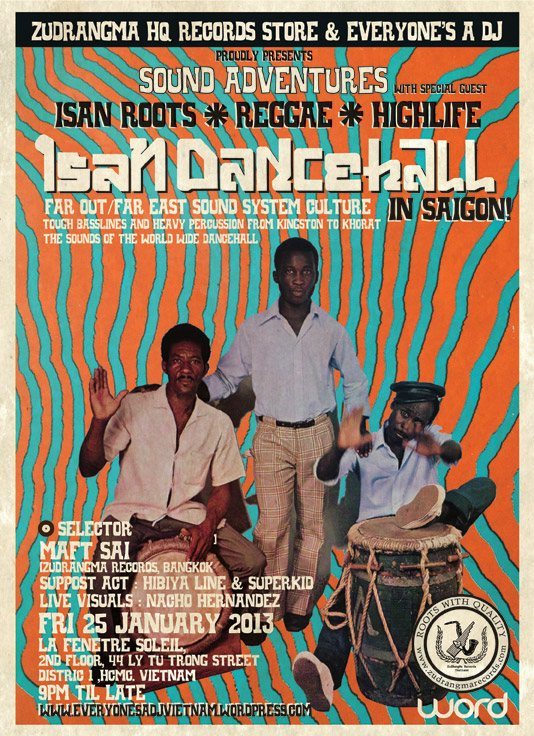
He has been collecting records and DJing for over 12 years, spinning an eclectic mixture of Roots Luk He has also taken his showcases further afield, to Vietnam, Singapore, Cambodian, Japan, France, Switzerland, Austria, UK, Germany and the US. He has also appeared as a dj on radio shows such as: “Beat in Space Radio Show” (New York), “Dublab Radio” (L.A.), “Pirates Choice Radio” (Osaka) “Northwave Radio” (Hokkaido) and many more.
He has also co-curated collections of left-field Thai music with Chris Menist for Finders Keepers Records “Thai? Dai! The Heavier Side Of The Luk Thung Underground”, for Soundway Records “The Sound Of Siam: Leftfield Luk Thung, Jazz & Molam 1964 – 1975 and ‘Diew Sor Isan : The North East Thai Violin of Thonghuad Faited’ for Em Records. Maft and Chris also run the record label ‘Paradise Bangkok’, which reissues underground vinyl gems from around the world.
Interview: Christopher Kirkley
Sahel Sounds, and Guerrilla Ethnomusicology

Christopher Kirkley is an archivist, artist, curator, and occasional DJ who runs the project Sahel Sounds. His work examines contemporary popular musics in an evolving technological landscape in the Sahara and Sahel regions of West Africa, from the interplay of localized traditions with transglobal influences to new media models of cultural transmission.
Sahel Sounds began as a blog in 2009 to share field recordings and has evolved into a record label, perhaps best known for its compilation Music from Saharan Cellphones. The blog continues as a platform to explore arts and music of the region through nontraditional ethnographic fieldwork. Currently, Chris is fundraising for the production of what may be the first-ever Tuareg language fiction film, Akounak Tedalat Taha Tazoughai (“Rain the Color of Blue with a Little Red in It”)—an homage to Purple Rain and The Harder They Come, and drawing on the experimental filmmaking of Poverty Row, Italian Neo-Realism, and Jean Rouch—which aims to provide an alternative to the dominant narrative of contemporary Tuareg music-as-rebellion by dramatizing the music scene in Agadez, Niger.
We recently discussed some of his projects, the relationship of his work to academic ethnography, and how digital music is being archived in the Sahel. Excerpts from our conversation are reproduced below.
The Sound of Space

The previously silent world of outer space is changing. In this audio tour around the Universe, Dr Lucie Green explores the sounds of space.
Some sounds have been recorded by microphones on-board interplanetary spacecraft. Others have been detected by telescopes and sped up until their frequency is tuned to our ears. The rest are sonified X-rays, space plasma or radio waves that reveal tantalising secrets about the universe that our eyes cannot see.
Everyone can recall the sound of the singing comet - a symphony created using measurements from the Rosetta mission. But many other sounds have been created from space data, from lightning on Jupiter to vibrations inside the Sun. From spinning pulsars to black holes and gamma ray bursts, outside our Solar System space becomes even stranger.
Subscribe to:
Posts (Atom)